
A couple weeks ago TCM showed a film I hadn’t seen in decades: The Miracle Worker.
As tempting as it is to digress into a review of the 1962 movie and of the performances of Anne Bancroft and Patty Duke, I won’t. If you haven’t seen it, do. If you have, do so again.
The horror that was the young life of Hellen Keller is overwhelming.
Anne Sullivan’s dedication, despite navigating waters that were, for her, completely uncharted, was inspiring. She had to communicate words and ideas in language that was unfamiliar to Helen – who couldn’t see, hear, or speak.
Seriously, watch the movie.
The. Miracle. Worker.
Many, many years ago there were concepts called Sacred and Profane. Generally, Sacred meant reserved for special (usually religious) use while Profane meant ordinary, everyday use.
A lot of us grew up with clothes that were our “Sunday Best” and the rest were “everyday” clothes.
There used to be distinctions in language as well. In some religious groups, members would address each other using “ye/thee/thou/thine” – an acknowledgement that they were children of god and deserving of respect. To address another “you/your” was reserved for outsiders – or considered an insult. “Everyday” language was profane – it wasn’t naughty, just not Sacred.
In Polite Society, as distinct from religious groups, citizens were taught proper grammar and how to speak clearly, respectfully, in a way which demonstrated, for lack of a better word, class. Remember Professor Henry Higgins and Eliza Doolittle? Proper language was, in many circles, equivalent to Sacred. Profane was the language of the lower classes – not necessarily Naughty, just not Proper.
And then there were sailors. In the days of wooden ships and iron, men spoke roughly, plainly, and loudly. How else could you communicate with your shipmates in the rigging, competing with the roaring of the waves and howling gale? And when, after months at sea, you made port – why speak differently? “A mouth like a sailor” didn’t necessarily mean Naughty… oh, hell – yes it did. “A mouth like a sailor” gave birth to other expressions, such as “make a sailor blush”. Nothing Sacred here, move along.
Some words are just profane, I.e. profanity. Nearly everyone understands that concept. There are (or were) “Seven words you can’t say on television”. Remember? To sailors those are Sacred words – reserved for special use, like when you’re breathing. To the rest of us they’re “fightin’ words, locker room talk, or gutter language”. We know, but often don’t take care.
Some words embody concepts that used to be Sacred but have, through profane use, lost their ability to inspire. Like the word “iconic”.
The word ‘miracle’ used to be Sacred. Nowadays it’s tossed around like just another overused superlative.
Anne Sullivan was a Miracle Worker. What she accomplished with Hellen Keller… Just. Did. Not. Happen.
Ever.
Stories are told of the stepson of a carpenter who was a Miracle Worker. Lame folks walked, blind folks could see, water to wine….
All flashy stuff and good for street cred.
But the Real Miracle was what he taught.
Love god, AND love your neighbor. Tell the truth, plainly and without deceit. Help the needy, don’t be greedy, and remember that the really important stuff isn’t… stuff.
About forty years ago I saw a “poster art” portrait. It was constructed using the words of the Sermon on the Mount. The letters and words were legible, but the script was expanded/ contracted, boldface/italics, straight/wavy, all printed so that the message – when viewed from a few feet away – appeared as a picture of a man.
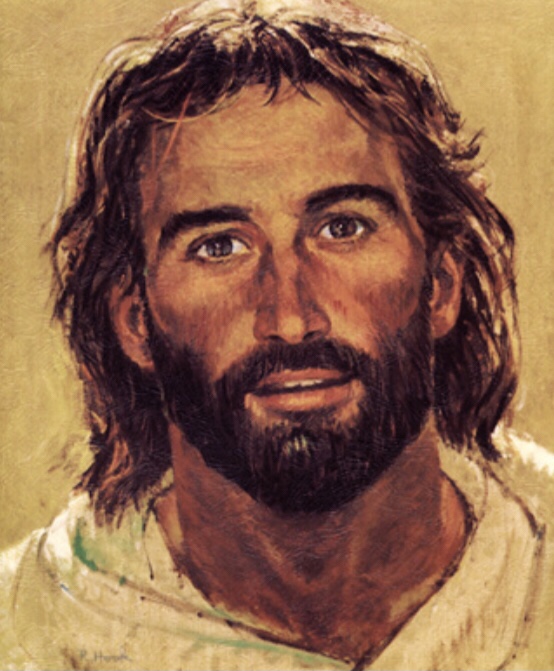
When I was young there was “Sallman’s Head Of Christ”; by the mid-1960s there were a couple popular paintings by Hook; and then the one I’ve described, painted in His own words.
Unmistakable.
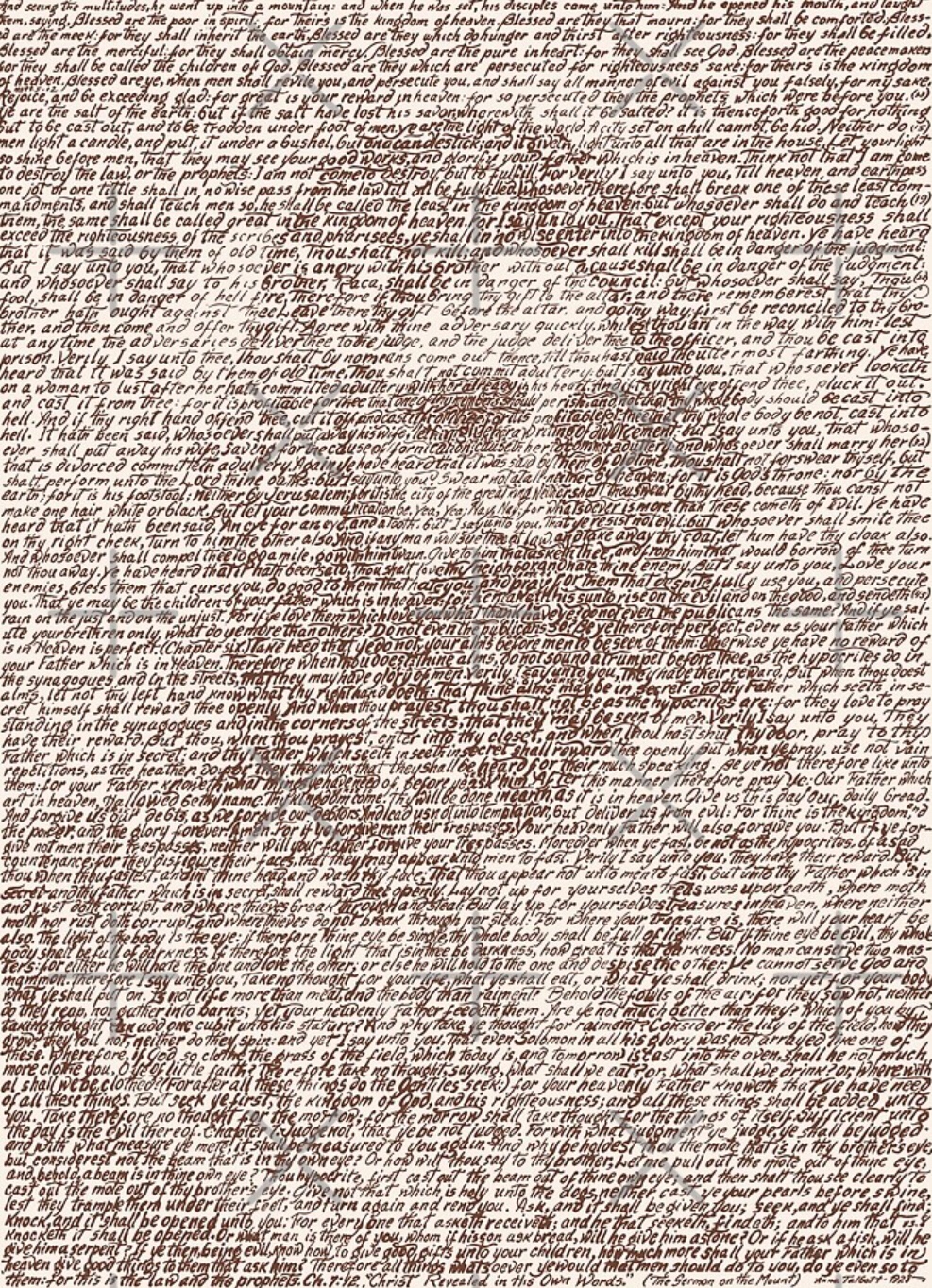
Without words – just brushes and paints – Hook’s art, like Sallman’s appeared in Sacred places.
I have no idea what sort of mental images Helen Keller had. What was in her mind’s eye when someone signed “water”, “puppy”, or “Jesus”?
Reading about her life, I’m sure that there were words, phrases, ideas and actions that were filed with “Jesus”: she was a tireless advocate for the poor, the outcast, the disenfranchised.
Helen’s life, her words, her actions paint a beautiful portrait.
Words do that. Actions do that. They evoke an image.
Usually the image is clear, or becoming so.
There is a lot of language lately that uses “sacred” words in ways that seem… different. The speakers claim to be associated with the stepson of a carpenter and insist that they understand what he taught. Listening to them makes me wonder if it’s the stepson of a different carpenter. From their actions, the words of their stepson paint a picture with some subtle, but noticeable differences:
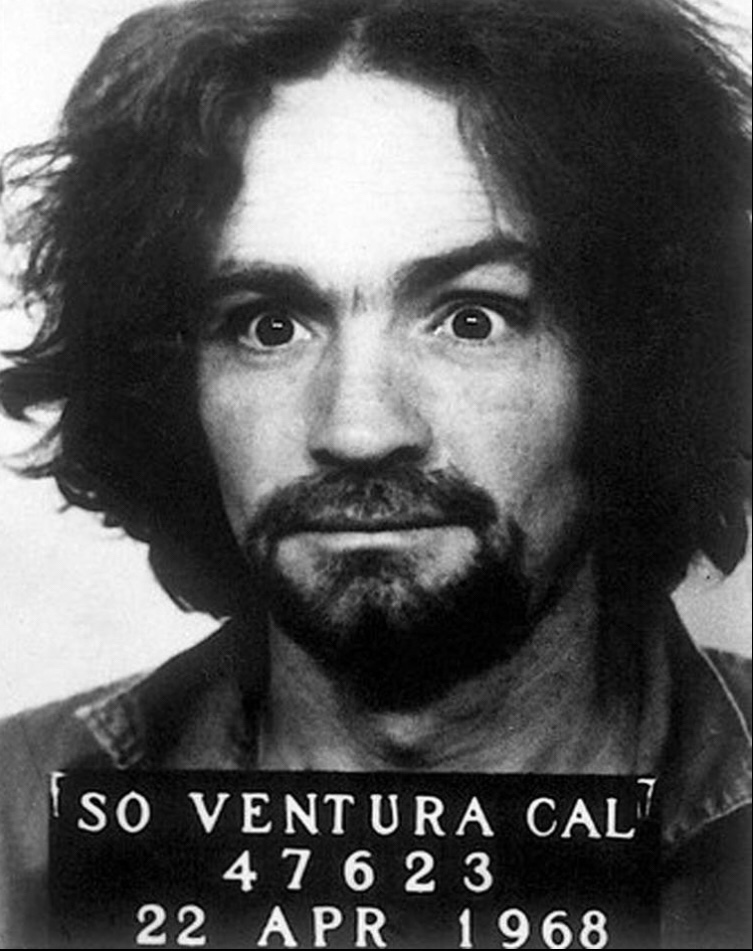
Doesn’t he look a little like Donna Reed around the eyes?
“By their fruits ye shall know them.”
 B & B
B & B 